
About the client
A multi-location dental clinic in Romania with its own in-house dental laboratory. The team consists of about 40 people: dentists, technicians, patient managers, call-center operators, a photo-video team, marketing, and management. The model is B2C: a patient comes in for treatment, the dentist designs a prosthetic work where needed (crown, bridge, denture, zirconia construction), the order goes to the in-house lab, and after fabrication returns to the dentist for placement.
The business specificity is vertical integration. The lab is not external — it is part of the clinic. This gives control over deadlines and quality but creates a unique operational challenge: a single order passes through four functional blocks (front office → dentist → laboratory → production workshop), and any communication breakdown between them turns into a delay.
What the client came to us with
Before Bitrix24 the clinic had a picture typical for the industry: patients lived in the medical information system, prosthetic orders lived on paper job tickets that technicians physically carried between rooms. Work statuses were tracked in Excel or “from memory”. Photo materials (“before/after”) were collected chaotically.
Main pain points:
- Impossible to answer “Where is patient X's work right now?” without walking through three rooms.
- Orders got stuck halfway. Nobody could see the full queue of works.
- Photo protocol was kept unsystematically. For one patient there were shots from three stages, for another — only the result. Finding the initial photo at a complaint a year later was a half-day task.
- No metrics existed. How many works are in production? What is the average cycle time? Where is the bottleneck? There were no answers.
The clinic evaluated options: a specialized laboratory system, customizing the existing medical information system, a separate CRM for orthopedics. The choice fell on Bitrix24 for three reasons: a unified workspace for the whole team, a deeply configurable CRM for non-standard processes, and a total cost of ownership incomparable with industry-specific software licensing.
The client came to us through a referral. An additional argument was that we agreed to build the process from scratch around their real operations, rather than forcing the business into a pre-built template.
How we built this
First — the map of the real process
Before configuring anything, we ran three working sessions — separately with managers, separately with dentists, separately with the lab. The goal was to put the real process on the table, not the one imagined by management.
What emerged: a single order has up to 30 control points — from the job ticket number and Vita shade scale to the inventory of physical components (impressions, screws, articulators). Zirconia works differ technologically from metal-ceramic so much that they cannot be pushed through the same pipeline. The production workshop is a separate world with its own operations, and a single customer deal can spawn several production units.
Architecture: pipeline plus smart processes
We built a multi-level model in Bitrix24.
- The main deal pipeline is the customer order journey from registration to the handover of the finished work to the dentist. Stages: job ticket registration → taken into lab production → validation → prototype → framework → fabrication → handed over to dentist → closed.
- Smart process “Zirconia works” — a parallel track specifically for zirconia: impression photo capture → casting and articulator mounting → scanning → CAD modeling → online consultation with the dentist → production.
- Smart process “Work fabrication” — the workshop card: milling → sintering → individualization → cementation → done. A single customer deal can spawn several such cards if the work consists of multiple units.
This model solves three problems at once: the patient manager gets a single interface “I see everything about the order”, the lab works at its own level of detail, management sees aggregated analytics.
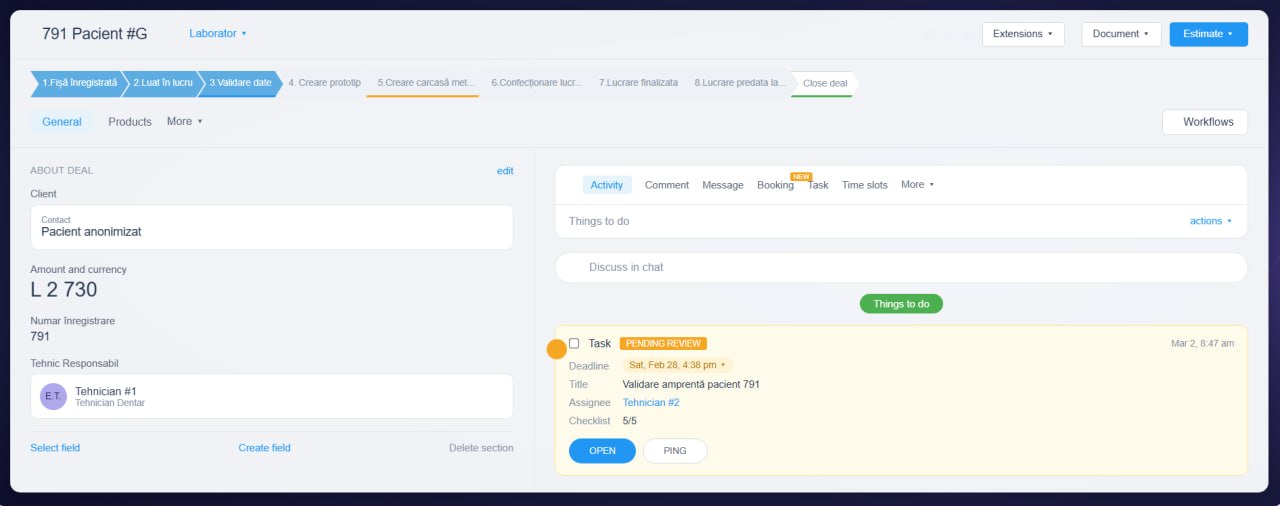
The digital lab job ticket
We moved the paper ticket into Bitrix24 as a set of custom deal fields, grouped into logical blocks: identification and deadlines, work parameters, clinical part, production checklist, end-to-end readiness, photo protocol, external integrations, and inventory of physical components.
The last block — about inventory — is often underestimated, and unfairly so. If an impression or a screw gets lost between rooms, without tracking you find out too late. That's why every component of the deal is described: how much was sent to the lab, how much came back.
Bitrix24 as an orchestration layer
A principled decision: Bitrix24 works not as an “all-in-one” system, but as a coordination layer on top of specialized systems. We did not try to replace the radiology and digital imaging system, the cloud storage for scans, or the lab's CAD system.
Instead, bridge fields appeared in the deal card: patient ID in external systems, links to scan folders, CAD model file names. The manager sees in Bitrix24 that the patient folder is created, the scan is uploaded, the CAD model is ready — but the files themselves stay in the specialized systems where they belong. Trying to stuff X-rays into a CRM creates more problems than it solves.
The photo protocol as part of the clinical procedure
“Before” and “after” photos in dentistry are first and foremost clinical documentation: fixing the initial state, verifying that the result matches the treatment plan, legal protection in case of disputes. Marketing use is secondary, and only with the patient's explicit consent.
We embedded a photo checklist directly into the deal card. The manager sees four separate fields: “Materials BEFORE photographed? Uploaded? Materials AFTER photographed? Uploaded?” The photo-video operator gets a task at a specific deal stage. If the photo isn't captured, the deal doesn't move forward without a tick.
A side effect: the marketing team got a structured archive of “before/after” pairs tied to works, from which cases for publication are selected after the patient's consent.
What was difficult
To avoid idealizing, here are the real difficulties.
- Lab resistance. The technicians were used to paper tickets, and the transition to digital stalled for the first two months. The solution — we didn't cancel paper right away. For two months technicians worked in parallel: paper ticket as a familiar physical document plus entry in Bitrix24. By the end of the second month it became visible that Bitrix24 held fuller and faster information, and paper was dropped without resistance.
- Zirconia works. Initially we tried to push them through the main pipeline, padding it with additional stages. It came out overloaded: the zirconia cycle is fundamentally different from metal-ceramic. After a month we moved zirconia into a separate smart process. The right architectural decision, but it required migrating orders already in progress.
- The deal ↔ production card link. When one deal spawns several production units (for example, a bridge of four crowns), we had to decide how to link them. We did it through attaching the production card to the parent deal.
What's used daily
- Patient manager creates the deal at first contact, tracks movement across stages, sees the photo checklist — and answers the patient's call without walking the rooms.
- Dentist sees their deals at the “Handed over to dentist” stage, knows which works are ready for today's patients.
- Lab supervisor sees the overall queue of works, distributes technicians, controls bottlenecks.
- Technician works with their own production card, moves it through stages milling → sintering → individualization → cementation.
- Photo-video operator gets the task at a specific stage; after capture, ticks “photo uploaded” in the checklist.
- Management sees aggregated analytics: number of works at each stage, bottlenecks.
What this gave the client
- End-to-end transparency. Any employee can answer “Where is patient X's work and when will it be ready?” in 10 seconds. Before Bitrix24 the same question required three phone calls and walking through two rooms.
- Controllable work queue. The lab sees its queue as a prioritized list with deadlines, not a stack of paper tickets. The supervisor distributes the load between technicians deliberately.
- The photo protocol became systematic. For every work there is a “before/after” pair tied to a deal. This covers three jobs at once: clinical documentation, internal quality control, and material for the marketing team in case the patient consents to publication.
- Analytics became possible. Answers appeared to questions that weren't being asked before, because there was nothing to count from: average production cycle duration, at which stage works get stuck the most, what share of orders goes out to external subcontractors.
- Employees stopped being a single point of failure. When all information lives in Bitrix24, a manager's or technician's vacation doesn't paralyze the process.
Technical outline
- Bitrix24 plan — cloud Professional.
- Main deal pipeline.
- 3 smart processes: zirconia works, production workshop, extended production control.
- Custom deal card fields: identification, work parameters, clinical part, production checklist, inventory of physical components.
- Business processes automate stage transitions and notifications for participants.
- Business processes for automatic patient notifications about work readiness status.
- Integrations via bridge fields with external systems: radiology and imaging, cloud scan storage, the lab's CAD system.
- Telephony connected through a Romanian SIP provider: incoming calls are automatically attached to deals, call recordings are available in the deal card.
- 40 active users.
What's in progress now
The implementation didn't end at “turnkey delivery”. Currently in active phase — configuring management dashboards with aggregated analytics on the production cycle.
This is the second phase of any serious implementation: the first stage gives transparency and order, the second automates what becomes visible and measurable after the first stage.
Who this is useful for
If you run a dental clinic with an in-house laboratory — you almost certainly recognized your own pain points in this text: paper tickets, lost impressions, unpredictable fabrication times, unsystematic photo protocol. The architecture transfers to similar clinics with minimal adaptations: the set of materials and types of works changes, the team composition changes, but structurally the process is the same.